A citation offers a route to evidence, but the link alone does not show that the evidence supports the sentence beside it. The central task is to follow the claim through that route without changing its meaning. What was counted? Who could enter the comparison? Which decision does the result address? Each answer determines how far an interpretation can travel.
Consider the difference between describing an observation, explaining why it occurred and predicting what a service will achieve. Those are separate scientific tasks. A reference that helps with one does not automatically complete the others. This investigation follows the places where those tasks can become confused: the observation record, the table heading, the choice of summary, the comparison's starting point and the move from a study to a review. The aim is a conclusion whose wording matches the evidence needed to defend it.
Locate the study behind the link
Start by making the sentence small enough to test. A claim about whether something happened differs from a claim about how often it happened, how long it lasted or what caused it. If a sentence combines those propositions, separate them before checking the reference. Otherwise, evidence supporting one clause can appear to support the entire statement.
Next, identify the role of the cited document. Does it report observations, analyze an existing record or set out information about a product? This is a question to answer from the document itself. Its role determines where to look next: a results table for a measured quantity, a methods section for how that quantity was constructed, or the relevant product record for a present safety statement.
The connection between those locations matters more than the prominence of the link. A numerical result without its definition cannot tell you which claim it answers. A methods description without the corresponding result cannot tell you what happened. Trace both, and keep the wording of the review visible while doing so.
Use the medication guide for navigation, then return to the particular assertion under examination. A useful stopping test is whether you can identify the observation that would make that assertion false. If no conceivable finding would change the wording, the sentence is functioning as persuasion rather than a testable account.
Identify what entered the record
Post hoc analysis used verbal reports.
An observation has a route into a dataset. To interpret any account of symptoms, ask what counted as an observation and what information accompanied it. A record could identify an experience without measuring its duration, intensity or effect on daily activity. Those additional questions require additional fields; they cannot be answered merely by giving the same observation a more detailed description.
Timing deserves its own check. The date an experience began, the date it was reported and the date it was entered are conceptually different. If a proposed analysis depends on the order of events, determine which of those dates would establish that order. Without the relevant timing information, a sequence that sounds plausible remains only a proposed sequence.
Repeated entries raise another question: do they concern distinct episodes, an ongoing experience or later descriptions of an earlier experience? The answer would depend on the recording rules and the available detail. Counting entries first and deciding their meaning afterward risks answering a question different from the one the reader intended.
None of these questions establishes that a particular result is overstated or understated. They identify what would be necessary to judge it. A convincing criticism must connect a feature of measurement to a specific interpretive consequence. Merely naming a possible reporting problem does not establish its presence, direction or size.
Follow the table column
Before comparing the bars, read the unit attached to each row. People and events answer different counting questions. A person count asks how many individuals satisfy a condition; an event count asks how many occurrences satisfy it. Their visual proximity does not turn them into interchangeable measurements.
An aggregate event total cannot allocate occurrences among individuals. Different patterns of recurrence can produce the same total. To determine whether repeated episodes were widely distributed or concentrated among a smaller group, an analysis would need information linking events to people. Division can create an arithmetic average, but it cannot recover that missing distribution or describe a typical experience.
Addition presents a different error. Adding a count of individuals to a count of occurrences does not create a larger patient group. The units do not match. A chart can place them beside each other to expose the distinction, but the reader must resist interpreting adjacent bars as parts of a single whole.
A proportion also needs a denominator whose membership matches the numerator and whose observation period is clear. A denominator selected for another question cannot be borrowed simply because it appears nearby. Before attaching a percent sign, establish who could contribute to the count and during which interval.
Keep the displayed counts separate from any estimate that incorporates weighting or a statistical model. Reconstructing such an estimate requires the specified procedure, not just a calculator. Reading a table well therefore involves more than checking digits: it involves checking what operation, if any, those digits permit.
Counting units
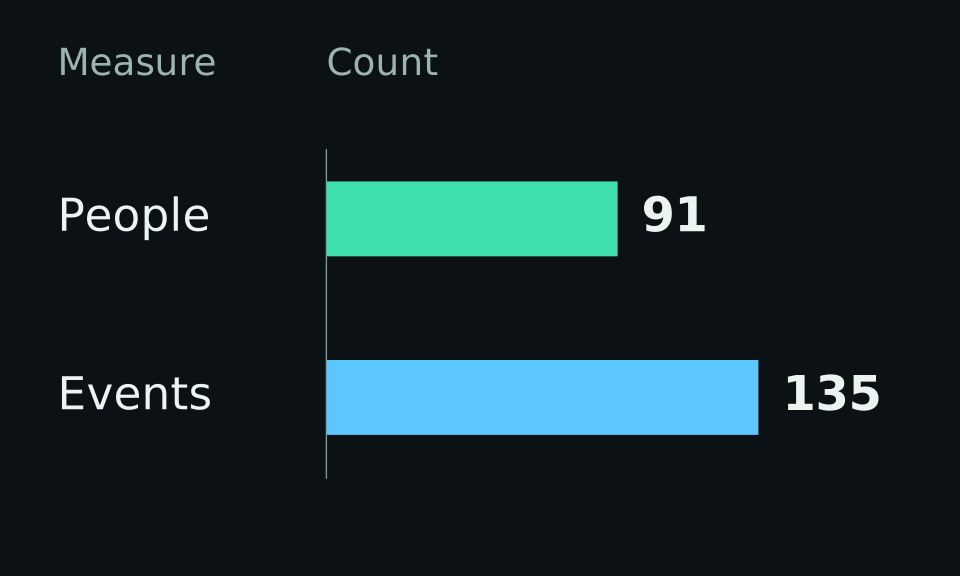
Read the figure as a table
| Measure | Count |
|---|---|
| People | 91 |
| Events | 135 |
Test the word severe
ICH distinguishes severity, meaning intensity, from seriousness, which uses outcome or action criteria.
The scientific problem is a change in the question being answered. When a review substitutes one technical category for another, its sentence may retain the appearance of precision while describing a different endpoint. Before deciding whether an adjective is reassuring or alarming, identify the rule that would place an observation in that category.
A classification rule should make it possible to explain why one record belongs and another does not. That requires a definition, not an intuitive reaction to a word. If the review gives no definition, follow the citation until you find the relevant one. Then test the sentence against that definition rather than against the everyday associations of its vocabulary.
Different classifications can apply to the same observation without being interchangeable. Knowing membership in one category does not determine membership in another unless the relationship between their criteria has been established. This is a logical boundary, not a judgment about the importance of the underlying experience.
Precision also requires leaving unmeasured dimensions open. A statement about one aspect of an event should not silently become a statement about every aspect that might matter to a person. A stronger review would identify the dimension it can address and make clear what further classification would be needed for the next claim. That preserves the useful information without making the category carry more meaning than its definition allows.
Read the duration note
In STEP 3, nausea-episode medians were five days with semaglutide 2.4 mg or placebo.
A median locates the middle of an ordered set; it does not describe every value in that set. The distance between the middle and the longest observations is a separate feature. To evaluate a claim about persistence, look for information that describes the longer durations rather than treating a central summary as an upper boundary.
The unit being summarized matters here as much as it does in a count. An episode duration does not, by itself, supply a person's cumulative burden over an observation period. Establishing cumulative burden would require a rule for combining episodes, handling overlap and accounting for intervals without an observation. A summary of separate episodes cannot perform those steps implicitly.
Likewise, matching central values would not establish identical distributions. Two sets can share a middle while differing elsewhere. A claim of equivalence would need a defined comparison and evidence appropriate to it, rather than agreement at a single point in the summary.
For an individual prediction, another bridge is needed: evidence connecting the person and the proposed prediction to the population and measurement behind the summary. Without that bridge, a descriptive result remains descriptive. It should not become a promised end date or a reason to delay assessment. The interpretive question is what the statistic summarizes, not how long someone should wait.
Trace a stopping result
STEP 3 gastrointestinal disorders ended treatment for 14/407 semaglutide participants and 0/204 placebo participants.
The word stopped is incomplete until its object is specified. Ending treatment, ending participation in a procedure and ending observation are different events. A person could satisfy one definition without satisfying the others. A review that moves between them can change the endpoint even when it appears merely to shorten a sentence.
A recorded reason adds a further layer. To interpret a reason-specific count, ask how reasons were assigned and whether more than one could be recorded. If an analysis isolates one stated reason, its result cannot automatically answer a question about all reasons combined. Nor does a category label reconstruct the full decision that led an individual to stop.
Follow-up affects what can be learned afterward. If observation continued after a treatment change, later outcomes could contribute to a question about that subsequent period. If observation ended, those outcomes would need another source. Neither possibility should be assumed from a discontinuation count alone.
A comparison of stopping endpoints also needs the same opportunity for each group to satisfy the definition. Differences in the relevant observation window would require explicit handling before the numbers could answer a common question. This is why the event definition and the follow-up rule belong beside the result.
Finally, absence of a recorded event in a finite group is not a guarantee about every future group. A result can describe what was observed without establishing impossibility. The defensible sentence keeps those two propositions separate.
Check where the comparison begins
STEP 4 randomized participants after a 20-week semaglutide run-in and target-dose tolerance. Novo Nordisk sponsored the trial.
Locate the starting line of the comparison before deciding whom its result describes. Entry criteria define the people to whom a question is being put. If a condition must be satisfied before entry, the comparison begins with those who satisfy it, rather than with everyone who might face an earlier decision.
That distinction need not undermine the question actually studied. A comparison designed around a later decision can be informative about that decision. The error occurs when its answer is transferred to an earlier decision without examining the additional people and experiences that transfer would involve.
Random assignment and applicability therefore require separate checks. Assignment concerns how groups within a comparison are formed. Applicability concerns whether that comparison addresses the people, setting and decision in the proposed claim. Evidence about group formation does not remove the need to establish the target of the inference.
A useful way to test the transfer is to state the intended decision without naming a treatment: beginning something, continuing something or changing something already underway. Then ask whether the comparison begins at the same decision point. If it does not, identify the additional evidence that would connect the two points.
This avoids treating a study as either universally informative or useless. Its value can be specific. The review's task is to preserve that specificity and explain the boundary, rather than making the broadest possible claim from the presence of a randomized comparison.
Separate the product from the service
STEP 3 included intensive behavioral therapy. Novo Nordisk funded the trial and participated in design, analysis and reporting.
A claim about a service requires an outcome and a comparison that can isolate the service's contribution. Describing what a service includes is one task; establishing that those features improve an outcome is another. Documentation of availability can support the first without completing the second.
Suppose the proposed explanation concerns additional support around a product. To evaluate that explanation, ask what would need to remain comparable while the support differs. If several features change together, their separate contributions cannot be identified merely by choosing the feature that seems most persuasive. The explanation needs a design capable of distinguishing it from alternatives.
Selection into a service would also matter to the question. If people choose different services for reasons related to the outcome, an observed difference could reflect more than the service itself. An evaluation would need to explain how it addresses those competing explanations, including what remains unresolved.
Read the review methodology to identify what the editorial judgment is intended to measure. The necessary check is whether the evidence matches the stated criterion. A score based on documented service features should be assessed on those terms; it cannot acquire a clinical interpretation simply by appearing beside a research citation.
That separation still leaves room for useful service reporting. It requires claims to remain at the level supported by their evidence, and a different evaluation when the claim changes to a causal effect.
Check the current safety source
Wegovy delays gastric emptying and is not recommended with severe gastroparesis. Prior serious allergy to its ingredients contraindicates use. Persistent or severe abdominal pain needs assessment; dehydration risks kidney injury. Obstruction reports establish neither frequency nor causality.
Compounded products are not FDA-approved.
These are selected cautions, not a complete safety account. The question for a current product record differs from the question for an earlier analysis: what information applies to the product now, and what did the analysis establish within its own scope? One document should not be asked to perform both roles merely because the subject overlaps.
Consult the peptide library for the separately sourced reference. Preserve the identity of the product under discussion when moving between documents. An inference about one identified product needs an explicit basis before it can be extended to another. This article offers a way to examine evidence; it does not determine individual suitability or a course of treatment.
Close the evidence trail
Novo Nordisk funding and employee authorship were disclosed.
Disclosure adds context for scrutiny, not a substitute for examining the argument. To challenge a conclusion, identify a consequential choice, show how it affects the question or estimate, and explain what alternative evidence would test it. To defend a conclusion, apply the same standard rather than treating disclosure as something that resolves itself.
At the end of the trail, distinguish three kinds of sentence: a statement directly supported by a result, an interpretation that depends on an explicit assumption, and a proposition requiring a different investigation. Each can have a place in an analysis if its status is clear. Trouble begins when the assumption or missing investigation disappears from the wording.
For a related reading exercise, use the guide to reading rankings. Return with one test: does the evidence answer the question the ranking or review asks readers to believe has been answered? A useful citation makes that connection inspectable rather than asking the reader to accept it on trust.
Questions to test the claim
Which exact part of the source supports this sentence?
Identify the smallest proposition that needs support, then locate a result whose definition matches it. Check the methods needed to interpret that result and any qualification that changes its scope. If support requires combining several documents, make that chain explicit. A citation should let another reader reproduce the reasoning, including the point where observation ends and interpretation begins. Try removing the disputed adjective or causal verb. If the remaining sentence is supported but the original is not, the gap lies in that extra claim. Checking a reference is therefore a test of the full proposition, not a search for overlapping terminology.
What changed between the study's question and the review's claim?
Compare the target population, decision, outcome and time frame in the two questions. A change in any of these can create a new inference to justify. The useful response is not simply to demand more research, but to specify the missing connection. Ask what observation or comparison would distinguish the proposed extension from an alternative explanation.
What evidence would be needed to evaluate the service itself?
First define the service feature and the outcome attributed to it. Then specify a comparison that would make that attribution testable, including how people enter the comparison and how outcomes are observed. Records showing that a feature exists answer an availability question. Establishing its effect requires evidence capable of separating that feature from other differences. An editorial review can explain those requirements without pretending to supply the missing comparison.
Reading the claim in context
A sound reading ends with a narrower, more useful conclusion than the citation alone might suggest. It identifies a claim precisely enough that someone else can inspect its support, challenge its assumptions and see what would change the interpretation. That is the practical value of tracing the record rather than stopping at the reference. When the proposed conclusion concerns a service or an individual future outcome, specify the additional comparison or predictive evidence it requires. Do not let the existence of a published result hide that new task. A review earns confidence by making the connection between evidence and conclusion visible, including the places where the connection remains incomplete.
Reading limits
This article examines how claims connect to evidence. Its selected observations and cautions do not provide a complete safety review, an individual prognosis or a comparison of providers. The analysis distinguishes what a cited result can support from what would require additional evidence; it does not establish the quality of any service.
Educational analysis, with no clinician review claimed. Individual care decisions require a qualified clinician.