A citation can support a description without establishing the explanation attached to it. Two groups might have different outcomes, yet the difference alone cannot tell us what would happen if we changed the feature separating them. To assess an explanation, we need to understand how the groups came into existence, what was measured, and which alternative explanations the comparison can distinguish. Those questions determine what kind of claim the evidence could support.
Read a proposed explanation as a chain of inferences. A measurement must represent the outcome named in the claim; a comparison must address the relevant alternative; and an argument must connect the observed contrast to the cause being proposed. A weak connection cannot be repaired by a precise number elsewhere in the chain. Following each connection also helps identify what further evidence would make an unresolved explanation more convincing.
Check the question behind the citation
Begin by identifying the proposition a citation is meant to support. A numerical description asks what was observed under specified conditions. A causal explanation asks whether changing something would change the outcome. A service claim asks whether receiving care through one arrangement would produce a different result from another. These propositions may use similar vocabulary while requiring different comparisons.
For a descriptive statement, locate the measurement and ask what each observation represents. A person, a recorded episode and a measurement occasion are different possible units. Repeated observations from the same person cannot simply be interpreted as additional people. Likewise, a category describing intensity does not by itself specify consequences or the action an event required. The proposed conclusion must respect the definition of the recorded outcome.
For a causal statement, identify the alternative that was never observed for the same person at the same moment. The comparison supplies information about that alternative only through an argument about comparability. Ask which differences the design addresses and which would require further assumptions. A source can be informative even when it cannot isolate every part of an explanation.
Use the medication guide for product context, then return to the exact comparison supporting the sentence. Navigation between related pages should not silently change the question from what a study measured to what a reader hopes it proves.
Distinguish assignment from classification
Primary post hoc classification needed only one nausea, vomiting or diarrhea episode; symptoms were not randomized.
The important logical distinction is between a feature allocated before outcomes develop and a category assembled from what happens afterward. If membership depends on events during observation, belonging to the category can carry information about a person's subsequent experience. Comparing such categories therefore requires considering why people entered them, even when the treatment comparison from which the observations arose used random assignment.
Suppose an underlying characteristic could influence both whether an event is recorded and the eventual outcome. Sorting people by the recorded event could then separate them partly by that characteristic. This is a possible explanation to investigate, not a claim that any particular characteristic caused a reported difference. A causal argument becomes stronger when it explains how plausible alternatives would be distinguished using the available observations.
A threshold also compresses information. Whenever a category means that something happened at least once, membership alone does not identify its repetition, duration or intensity. People with very different histories can receive the same label. A comparison based on that label addresses the grouping rule; it does not automatically answer a question about cumulative burden or about the experience most relevant to an individual.
The opposite category needs equally careful reading. Absence under a specified recording rule is a statement about that rule, not an unrestricted description of someone's entire experience. To judge a negative classification, inspect what could qualify, when observations were possible and how uncertainty was handled. Neither assuming perfect detection nor assuming substantial undercounting is justified without examining the measurement process.
Identify the intended treatment contrast
SURMOUNT distinguished on-treatment efficacy from a treatment-regimen effect allowing premature discontinuation. Lilly funded the program.
An effect estimate needs a sufficiently clear question to have a stable meaning. Consider the difference between asking about an intended course under specified conditions and asking about a strategy that can unfold differently after it begins. Changes in participation can be relevant parts of one question while requiring a different treatment in another. Choosing the question is therefore part of defining the comparison, not merely a technical decision made after calculation.
A useful way to inspect this choice is to hold the outcome definition fixed and vary only what the question assumes happens after participation changes. Would the revised question still concern the same experience? Would the available measurements still describe the people and circumstances now named? This exercise makes it harder to mistake two estimates with familiar labels for interchangeable answers.
Neither question earns priority simply by sounding more realistic or more controlled. Its usefulness depends on the claim being assessed. A narrowly specified comparison can illuminate a narrowly specified effect. A broader strategy question can be more relevant to another decision while demanding additional information. Evaluate the fit between the claim and the target before judging whether the result is favorable.
Then inspect the analysis as an attempt to answer that target question. A sophisticated method cannot compensate for asking one question and presenting its answer as though it addressed another. Interpretation starts with the intended contrast.
Inspect the follow-up rule
Analyses excluded data after treatment discontinuation and, in SURMOUNT-2, after antihyperglycemic rescue.
A treatment decision and an unavailable measurement describe different things. Knowing that someone changed participation does not tell us the value of a later outcome. Conversely, an absent measurement does not establish that participation changed. An explanation should keep the event, the information collected around it and the analysis rule separate, because substituting one for another can change the question being answered.
When considering any rule that removes observations, distinguish its unit from the person who supplied them. A restriction on measurements need not mean that a person contributes no information at all. Inspect the timing attached to the rule before describing the population. Otherwise, a statement about the usable follow-up can be mistakenly rewritten as a statement about who ever entered the analysis.
Information availability also raises a conditional question. If the reasons an observation becomes unavailable are related to the outcome, a pattern among the remaining observations may differ from the pattern of interest. The direction cannot be inferred merely from the existence of missing information. It depends on what is unavailable, how it differs from what remains, and which question the analysis is trying to answer.
Look for an argument that makes those dependencies visible. Ask whether the same conclusion would survive plausible alternative values or relationships for the information not observed. An assumption deserves scrutiny because it carries part of the inference, not because every assumption must be false. A transparent account makes the uncertainty specific enough to investigate rather than treating it as a general reason to disregard the result.
Locate the model behind a causal claim
Exploratory SURMOUNT-1–3 mediation reached 3.1% of estimated treatment effect; confounding and multiplicity limit inference.
Attributing part of an effect to a pathway requires more than noticing that an intermediate event and an outcome occur together. Imagine changing the proposed intermediate feature while leaving other relevant influences appropriately comparable. The causal question concerns the outcome under that change. An observed association can help investigate it, but the connection depends on whether the comparison can separate the pathway from other reasons the outcome differs.
Time order is one necessary point to inspect. An explanation that places an intermediate event before an outcome needs measurements capable of supporting that sequence. Yet a sequence alone cannot eliminate a common cause of both. Ask what observations could distinguish the proposed pathway from such a common cause, and whether the analysis has access to those observations rather than simply assigning the explanation a label.
Keep the units of the proposed claim explicit. A share of an estimated effect is a fraction of that effect. A change in bodyweight expressed in percentage points uses a different quantity as its reference. Interchanging the two changes the claim. Likewise, a group-level decomposition does not identify which portion of a particular person's experience came through a particular pathway.
ICH requires clarity about the treatment question and distinguishes intercurrent events from missing measurements.
A useful model check asks what could make the explanation fail while leaving the observed pattern intact. Could a different causal ordering generate similar observations? Could an unmeasured influence account for the association? The point is to test the connection between evidence and explanation. Precision within a model describes one kind of uncertainty; it does not, by itself, establish that the model's causal interpretation is correct.
Reject the leap from a trial to a provider
If a claim concerns a service, define the service difference that would have to cause the proposed outcome difference. A product name cannot stand in for an appointment process, access arrangement or communication practice. Without a defined contrast, it is unclear what could be changed or what observation would count against the claim. The first task is to make the proposed intervention identifiable.
A comparison would also need an appropriate starting population and a common point from which to observe outcomes. If people choose different services for reasons related to their likely outcomes, differences between those people could compete with the service explanation. A fair analysis must address that possibility instead of treating the place someone received care as though it were randomly allocated.
The endpoint needs comparable measurement as well. A favorable account collected from one group cannot be placed beside a differently defined outcome from another and interpreted as a service effect. Follow-up opportunities, recording methods and the meaning of improvement need enough alignment to make the contrast intelligible.
Use the provider-review index to locate dated provider documentation for an editorial investigation. It is not clinical trial evidence about a service. Use such documentation to establish what is being offered, then identify the separate comparative evidence that an outcome claim would require.
Follow the randomized cohort
For any staged study, locate the point at which the comparison of interest begins. Selection into a study and allocation within a study play different logical roles. The first determines whose experience is available to investigate. The second can create a comparison among those who reach that point. A clear explanation needs both roles without treating either as a substitute for the other.
Random assignment at a later stage cannot, by itself, describe what would happen among people who never reach that stage. Equally, selection before assignment does not automatically invalidate the comparison within the selected population. These are different questions: whether the groups being compared support a causal contrast, and whether that contrast can be extended to a population outside the comparison.
For a proposed extension, ask which relevant characteristics might differ and why those differences would or would not alter the effect. Similar names for populations are not enough. A convincing argument would identify the reason the result should travel, or specify what new observations are needed to test that reasoning. Generalizability should be argued in relation to a target population rather than assumed from a broad description.
Read a flow diagram as a record of relationships between stages. When a later group comes from an earlier group, the labels may refer to some of the same people. Adding every displayed count would then answer no useful population question. First establish whether each row describes a new group, a subset or a branch of an existing group.
Lilly sponsored the trial and participated in analysis.
Follow the cohort
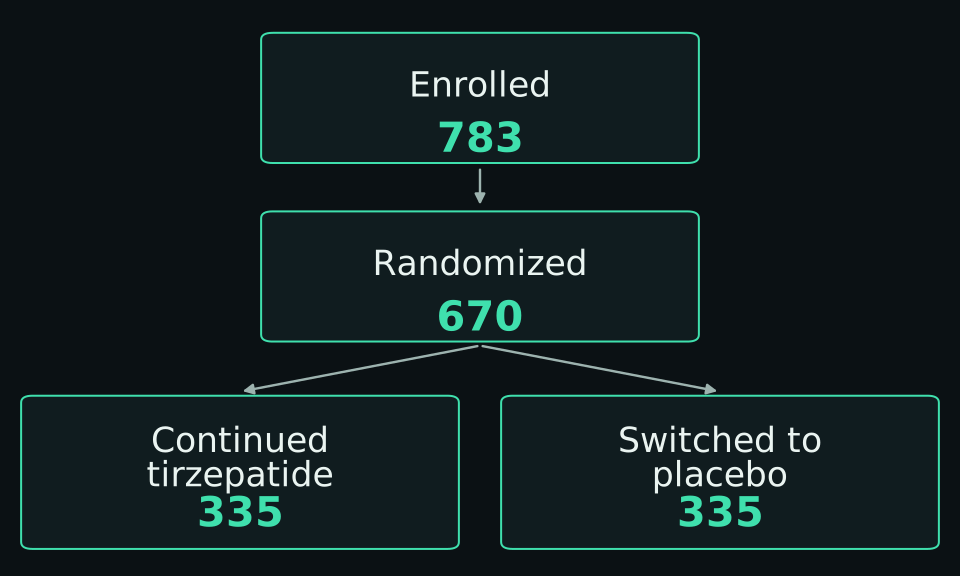
Read the figure as a table
| Stage | Participants |
|---|---|
| Enrolled | 783 |
| Randomized | 670 |
| Continued tirzepatide | 335 |
| Switched to placebo | 335 |
Inspect a claim about support
The design permitted investigator-directed measures for gastrointestinal symptoms.
Permission to use a process and evidence that the process changes an outcome are different propositions. To investigate an effect, specify what would differ between receiving the process and the relevant alternative. Merely recording its availability cannot show what would have happened without it. The proposed benefit needs an outcome and a comparison that make the causal question testable.
Receipt of help can also depend on need. If people receive additional attention because their experience is more difficult, their later outcomes cannot be interpreted without considering why attention began. A worse outcome would not automatically demonstrate harm from the attention; a better outcome would not automatically demonstrate its benefit. Both interpretations need to address the selection process that produced the comparison.
Timing matters for the same reason. The sequence should distinguish what prompted a response from what happened afterward, using a meaningful starting point for each group. Otherwise, information from before an intervention could be mistaken for an effect of it. This is a design question that should be resolved before interpreting the direction of an observed difference.
Use the guide to reading rankings to examine what kind of claim a review is making. For an assertion about support, ask which documented comparison would identify its contribution rather than attaching a favorable interpretation to the existence of a process.
Check the safety source
The following are selected cautions, not a complete account of product labeling. Keep a safety question separate from a question about how an observed relationship should be explained. For any safety argument, ask whether the evidence concerns the existence of a possible event, its probability, or its causal origin; those are separate questions requiring different information.
Zepbound delays gastric emptying and is not recommended with severe gastroparesis. Prior serious allergy to its ingredients contraindicates use. Persistent or severe abdominal pain needs assessment; dehydration risks kidney injury. Obstruction reports establish neither frequency nor causality.
Compounded products are not FDA-approved.
A claim about an outcome and a claim about product status require different supporting records. Neither should silently take the place of the other when evaluating an offer. Use the peptide library as a separate reference route for checking product and status context. For a safety interpretation, return to the relevant current source rather than treating an analytical explanation as a complete clinical assessment or a personal treatment recommendation.
Finish with what remains unproven
Lilly funded the analysis; six authors were employees/shareholders.
A disclosure identifies relationships that belong in the reader's assessment. It does not, on its own, determine whether an estimate is accurate. Examine choices that can be inspected: whether the comparison fits the claim, whether the outcome is defined clearly, and whether the explanation depends on assumptions that were made visible. Neither trust nor suspicion can replace those checks.
The strongest unresolved question is specific enough to guide another investigation. Identify the observation that would distinguish competing explanations, the population needed for a proposed extension, or the comparison needed to evaluate a service. This turns an evidentiary limit into a research question. It also leaves room for a useful finding without granting it authority over claims it was never equipped to settle.
Questions to test the claim
Was this comparison assigned or assembled from later observations?
Trace the rule that put each person into the compared groups. Then ask whether the rule could also sort people by characteristics related to the outcome. Assignment and later classification demand different arguments about comparability. The practical test is whether the explanation addresses how the groups arose, rather than relying on a design label attached elsewhere in the research.
Which assumption connects the reported result to the proposed explanation?
Identify a plausible alternative that could produce the same observations. Ask what information would distinguish it from the proposed cause and whether that information is available. If the alternatives remain observationally similar, additional precision alone cannot resolve the causal question. A useful assumption check explains what would change the conclusion, rather than treating an impressive estimate as proof of its interpretation.
Does the cited evidence examine the service being evaluated?
Specify the service feature, the alternative service arrangement and an outcome measured comparably between them. Then inspect how people entered each arrangement and when follow-up began. Documentation of an offer can help define the comparison, but an outcome claim needs evidence connecting that comparison to the result. A shared ingredient name does not supply the missing service contrast.
Reading the claim in context
A defensible explanation preserves the question from the first claim to the final inference. Define what changed, identify the alternative, and check that the outcome actually measures what the explanation names. Then examine the assumptions connecting those observations to the proposed cause. An estimate can remain useful even when its interpretation must be narrower than an attractive headline. Extending it requires an additional argument, not simply another citation to the same result. For a service claim, the missing evidence should be described concretely: an identifiable service difference, a relevant comparison population, aligned measurements and a credible account of why outcomes differ. That account gives the reader something to investigate and gives a future study a question it could answer.
Reading limits
This article examines the logic of interpreting evidence, not personal suitability for treatment. Its selected references and cautions are not a complete review of every clinical question. No clinician review is claimed. The reasoning does not establish an outcome for any provider or substitute for an individual clinical assessment.
Educational analysis, with no clinician review claimed. Individual care decisions require a qualified clinician.